Choosing a wheelchair accessible minibus for a care home is not quite the same as choosing one for a school or community group.
Residents can have a wide range of mobility needs within the same group, from ambulant residents who simply need an easier step into the vehicle to wheelchair users who need a secure and comfortable way to travel. Staff may also need to load mobility aids, care equipment or other items alongside passengers.
Getting the specification right from the start can make a significant difference to how useful the vehicle is day to day. This guide covers the practical things to consider when buying a wheelchair accessible minibus for a care home, whether you’re replacing an ageing vehicle or specifying one for the first time.
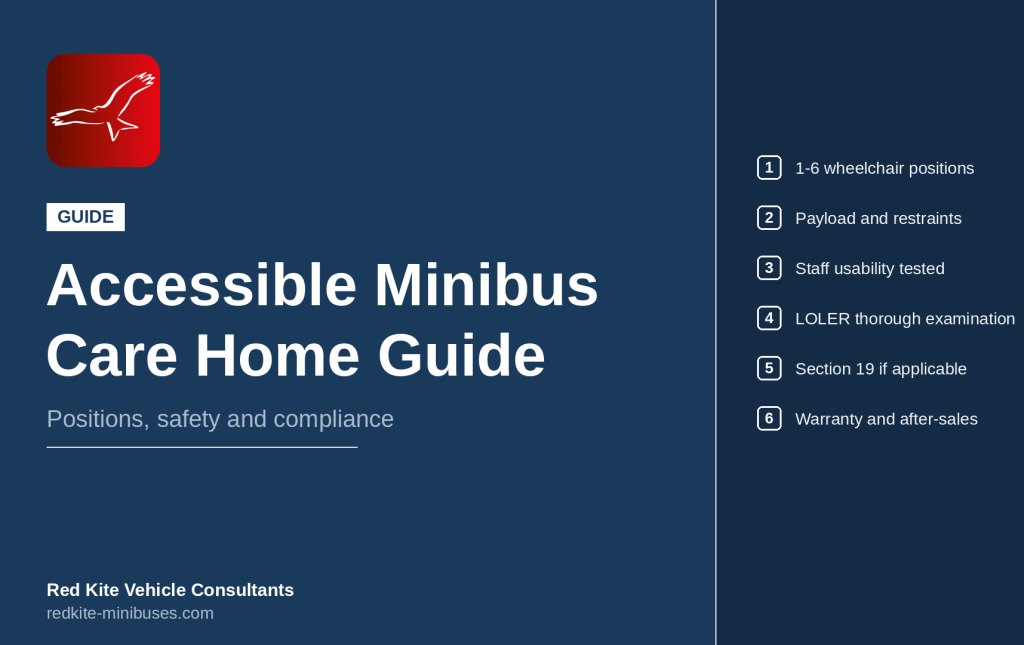
Download the full care home buyer’s guide (PDF) →
What Is a Wheelchair Accessible Minibus?
A wheelchair accessible minibus is a minibus configured to carry one or more passengers travelling in wheelchairs alongside other seated passengers.
The exact layout varies considerably between vehicles and conversions. Red Kite’s range, for example, can be configured with between one and six wheelchair positions, with the remaining space used for standard or removable seating.
That flexibility can be particularly useful for care homes. The number of wheelchair users travelling may vary from one outing to the next, so a vehicle with a configurable layout can provide more flexibility than one designed around a single fixed passenger arrangement.
The broader term WAV (wheelchair accessible vehicle) can also refer to cars and other passenger vehicles, so when comparing suppliers, make sure you’re comparing the actual vehicle type and passenger configuration you need.
How Many Wheelchair Positions Do You Need?
Start with how the vehicle will normally be used rather than simply specifying the maximum possible number of wheelchair positions.
Consider:
- How many residents currently use a wheelchair full-time?
- How many residents transfer from their wheelchair into a passenger seat?
- How many wheelchair users normally travel together?
- How many staff or passenger assistants travel with the group?
- How much mobility or care equipment needs to come along?
- How often will you need the vehicle at maximum wheelchair capacity?
A care home may find that two or three wheelchair positions provide a useful balance between wheelchair capacity and conventional seating, but the right configuration depends on your residents and typical journeys.
Plan for your typical journey, not your maximum capacity
A vehicle designed for the largest possible group isn’t necessarily the most practical vehicle for everyday use.
If most outings involve two wheelchair users and several ambulant residents, for example, a layout that provides those wheelchair positions while retaining comfortable conventional seating may be more useful than maximising wheelchair capacity at the expense of everything else.
Removable or folding seats can also provide flexibility as the needs of your resident group change.
Think About Payload and Passenger Weight
Payload is an important consideration when specifying an accessible minibus, particularly when the vehicle will carry several wheelchair users and staff alongside mobility or care equipment.
The total weight of passengers, wheelchairs, mobility aids, luggage and other equipment needs to remain within the vehicle’s permitted limits.
Don’t just ask how many people the vehicle can physically accommodate. Ask the supplier to explain the available payload for the proposed configuration and how that changes with different wheelchair and seating arrangements.
This is particularly important if residents use heavier powered wheelchairs or mobility equipment.
A good supplier should be able to explain the relevant weight limits and help you understand how the proposed configuration works in practice.
Wheelchair Restraints and Passenger Safety
The number of wheelchair positions is only part of the specification. You should also understand how wheelchair users and their wheelchairs are secured during travel.
Ask the supplier:
- What wheelchair restraint or tie-down system is provided?
- How is the wheelchair secured at each position?
- What passenger restraint is provided for wheelchair users?
- What wheelchair sizes and weights can each position accommodate?
- Can the restraint system be operated comfortably by staff?
- What training is provided?
- Can you see the complete loading and restraint process during a demonstration?
Wheelchair restraint systems need to be used correctly, so staff should understand how the particular equipment supplied with the vehicle works.
For a care home, ease of use matters as well as the equipment itself. If staff find a restraint system complicated or time-consuming during a demonstration, that is worth considering before committing to the vehicle.
Wheelchair Lifts and Ramps: What to Look For
The lift or ramp is one of the parts of the vehicle that staff and passengers will interact with most frequently, so it’s worth comparing the options carefully.
Powered wheelchair lifts can provide assisted access for passengers who cannot safely negotiate a ramp. Different lift designs are available, including underfloor systems that can be stored beneath the vehicle when not in use.
Ramps can provide a simpler access solution for some vehicle configurations, particularly where the vehicle layout and passenger requirements make them appropriate.
For ambulant passengers, features such as powered side steps can make boarding easier. A lowering suspension or “kneeling” function can also reduce the effective step height on suitable vehicles.
There isn’t one universally correct choice between a lift and a ramp. The right option depends on factors including the vehicle layout, wheelchair capacity, available space, loading requirements and how the vehicle will be used.
If the vehicle has a powered wheelchair lift used to raise and lower people, LOLER may apply. Where it does, the equipment will generally require a thorough examination at the applicable interval. Our guide to LOLER testing for minibus wheelchair lifts explains the requirements in more detail.
Comfort, Dignity and Accessibility
A wheelchair accessible minibus isn’t simply a way of moving passengers from one place to another. For care-home residents, the experience of travelling can be just as important as the vehicle’s technical specification.
When viewing a vehicle, consider:
- How easy it is for residents to board
- How much space there is around each wheelchair position
- Whether passengers can travel comfortably for longer journeys
- Heating and ventilation
- Interior lighting and visibility
- Noise levels
- Ease of communication between passengers and the driver
- Whether the loading process feels calm and dignified
If possible, involve the people who will actually use the vehicle in the buying process. A specification that looks good on paper may feel very different when a resident is actually boarding and travelling in it.
Storage for Wheelchairs, Walking Frames and Care Equipment
Storage is easy to overlook when you’re concentrating on passenger capacity.
Care-home outings may involve walking frames, spare wheelchairs, bags, coats and other equipment. If these items have nowhere secure and practical to go, they can quickly make an otherwise well-designed vehicle feel cramped.
Think about what normally travels with your residents and ask the supplier to demonstrate where it will be stored.
If residents regularly travel with oxygen or other care equipment, discuss the specific equipment and required storage or transport arrangements with the supplier before finalising the layout. Equipment that needs to be used during a journey may have additional safety considerations.
Make Sure Staff Can Use the Vehicle Safely
The people buying the minibus aren’t necessarily the people who will use it every day.
Care staff may need to:
- Deploy the lift or ramp
- Help position a wheelchair
- Apply wheelchair restraints
- Fit passenger restraints
- Load walking frames or other equipment
- Assist residents into their seats
- Return the vehicle to its travelling configuration
Ask the supplier to demonstrate the complete process, rather than simply showing you the vehicle parked with the lift deployed.
Ideally, have one or more members of your own team try the process themselves.
You’ll quickly discover whether the lift, restraints, seating and storage arrangements are genuinely practical for your staff.
Training should also be considered. Where specialist equipment such as passenger lifts or wheelchair restraint systems is used, staff should receive appropriate instruction and training.
Compliance: Vehicle Approval, LOLER and Permits
There are several different compliance considerations when buying and operating an accessible minibus. They should not be treated as one single requirement.
Vehicle approval
When buying a new or converted accessible minibus, ask the supplier what vehicle approval applies to the specific vehicle and request the relevant approval or certification documentation.
The applicable approval route can depend on the vehicle, its construction and conversion history, its configuration and other circumstances. Don’t assume that every accessible minibus follows exactly the same approval process.
LOLER
Where a powered wheelchair lift is used as lifting equipment at work to lift people, LOLER will generally apply.
For equipment used to lift people, the prescribed thorough-examination interval is normally at least six months unless a different interval has been established through a competent person’s written examination scheme.
LOLER is separate from normal vehicle servicing and roadworthiness requirements. Read our guide to LOLER testing for wheelchair lifts for more information.
Section 19 permits
Depending on who operates the vehicle, how the transport is provided and the nature of the organisation, different operator licensing or permit requirements may apply.
A Section 19 permit is relevant to certain qualifying not-for-profit organisations providing transport for their own members or for people the organisation exists to help.
A care home should therefore establish which operator licensing or permit arrangements apply to its own circumstances rather than assuming that every care home needs a Section 19 permit.
Our Section 19 guide explains the permit system in more detail.
New vs Used Accessible Minibuses
The choice between new and used will usually come down to budget, timescale, vehicle availability and how closely you need the specification to match your requirements.
Buying new
A new accessible minibus gives you greater opportunity to specify the vehicle around your requirements, including:
- Number of wheelchair positions
- Seating configuration
- Lift or ramp type
- Interior finish
- Storage
- Accessibility features
- Optional equipment
The trade-off can be lead time, particularly where the vehicle is being built or converted to a bespoke specification.
Ask the supplier what warranty applies to both the base vehicle and the accessibility conversion, as well as what after-sales support is available once the vehicle is in service.
Buying used
A good-quality used accessible minibus can reduce the initial purchase cost and may be available more quickly than a new bespoke conversion.
However, don’t assess a used accessible minibus solely on its mileage and age. Pay particular attention to:
- Condition of the wheelchair lift or ramp
- Wheelchair restraint systems
- Conversion condition
- Vehicle service history
- MOT history
- Tyres and brakes
- Interior condition
- Evidence of previous repairs
- Payload and passenger configuration
- Applicable approval documentation
- Warranty
- Availability of specialist after-sales support
If possible, have the vehicle inspected independently before purchase.
For either a new or used vehicle, ask what happens if the lift, restraint system or another specialist component needs attention after purchase. Specialist after-sales support can be particularly valuable with accessible vehicles.
What to Ask a Minibus Supplier
Before choosing a wheelchair accessible minibus for your care home, ask the supplier:
- How many wheelchair positions does this configuration provide?
- What wheelchair sizes and weights can each position accommodate?
- What wheelchair restraint system is supplied?
- What passenger restraints are provided?
- What is the available payload in this configuration?
- Can the seating layout be changed later?
- How easy is the lift or ramp for staff to operate?
- Can our staff try the loading and restraint process themselves?
- What training or instruction is provided?
- Where will walking frames, wheelchairs and other equipment be stored?
- What approval or certification documentation comes with the vehicle?
- What warranty applies to the base vehicle and conversion?
- Who can provide servicing and specialist support?
- What happens if the vehicle needs specialist repairs?
- What is the expected lead time?
A supplier who can answer these questions clearly should make it easier to compare vehicles on more than just purchase price.
Quick Reference: What to Check When Buying
| Feature | What to Check |
|---|---|
| Wheelchair positions | Matches your typical passenger requirements, not simply the maximum possible capacity |
| Wheelchair restraints | Appropriate restraint/tie-down system, passenger restraints and compatibility with your wheelchairs |
| Payload | Available weight capacity for passengers, wheelchairs and equipment in the proposed configuration |
| Seating flexibility | Removable or folding seats where appropriate, with suitable passenger restraints |
| Lift or ramp | Suitable for your residents, staff and typical loading requirements |
| Staff usability | Staff can safely operate the access equipment and restraints |
| Comfort and accessibility | Boarding, interior space, seating, heating, ventilation and ease of movement |
| Storage | Practical space for walking frames, wheelchairs and other equipment |
| Vehicle approval | Relevant approval/certification documentation for the specific vehicle |
| LOLER | Appropriate arrangements for thorough examination where applicable |
| Operator requirements | Check whether PSV licensing, Section 19 or another arrangement applies |
| Warranty and support | Clear warranty terms for the base vehicle and conversion, plus specialist after-sales support |
Frequently Asked Questions
The number varies according to the vehicle, conversion and seating configuration. Red Kite’s range can be specified with between one and six wheelchair positions, with the remaining space configured with standard or removable seating.
The right number for a care home depends on how many wheelchair users normally travel together and how much conventional seating you need for other residents and staff.
Where a powered wheelchair lift is used as lifting equipment at work to lift people, LOLER will generally apply and a thorough examination will normally be required.
For equipment used to lift people, the prescribed interval is normally at least every six months unless a different interval has been established through a competent person’s written examination scheme.
See our LOLER testing guide for the full explanation.
Not necessarily.
Whether a Section 19 permit or another operator licensing arrangement applies depends on factors including the organisation, how the vehicle is operated and how the transport is provided.
Care homes should check their own circumstances rather than assuming that a Section 19 permit is automatically required.
Our Section 19 guide explains the permit system in more detail.
A powered lift mechanically raises and lowers passengers, while a ramp provides an inclined surface for wheelchair access.
The appropriate choice depends on the vehicle layout, passenger requirements, wheelchair capacity and how the vehicle will be used. Ask to see both options in operation if you’re unsure which would work best for your care home.
Many accessible minibuses can be specified with removable or folding seats, allowing the balance between wheelchair positions and conventional seating to be changed.
The exact options depend on the vehicle and conversion, so ask the supplier to demonstrate the configurations available for the vehicle you’re considering.
Look beyond the vehicle’s age and mileage. Check the condition and history of the accessibility conversion, lift or ramp, wheelchair restraint systems, vehicle servicing and MOT history.
You should also establish the vehicle’s payload, approval documentation, warranty and available after-sales support. An independent inspection can provide additional reassurance before purchase.
Warranty arrangements can vary depending on the vehicle and whether it is new or used. Ask Red Kite to confirm the current warranty that applies to the specific vehicle, including any separate cover for the base vehicle and accessibility conversion.
You can also find more information on our warranty page.
Specifying the Right Accessible Minibus for Your Care Home
Every care home’s resident group is different, so the right specification comes down to how the vehicle will actually be used.
Think about your typical passenger mix, wheelchair positions, payload, access equipment, restraint systems, storage, staff usability and passenger comfort before deciding on the final layout.
Most importantly, don’t buy from a brochure alone. Arrange a demonstration and, where possible, bring along the staff who will actually use the vehicle. Work through the complete process of boarding, loading a wheelchair, applying the restraints, storing mobility equipment and preparing the vehicle for travel.
Red Kite can help you compare configurations and understand how different accessible minibus layouts would work for your care home.
Explore our wheelchair accessible minibus range →
Or call 01202 827678 to arrange a no-obligation demonstration at a time and location convenient to you.
This guide is intended as general information only and should not be relied upon as legal, regulatory or technical advice. Vehicle approval, operator licensing, permit and lifting-equipment requirements depend on the specific vehicle and circumstances. Always check the current requirements and seek appropriate professional advice where necessary.
Red Kite Vehicle Consultants Ltd, 3 Haddons Drive, Three Legged Cross, Wimborne, Dorset BH21 6QU
Tel: 01202 827678 | Email: info@redkite-minibuses.com