If your organisation uses a wheelchair-accessible minibus with a powered lift, you may have responsibilities under the Lifting Operations and Lifting Equipment Regulations 1998 (LOLER).
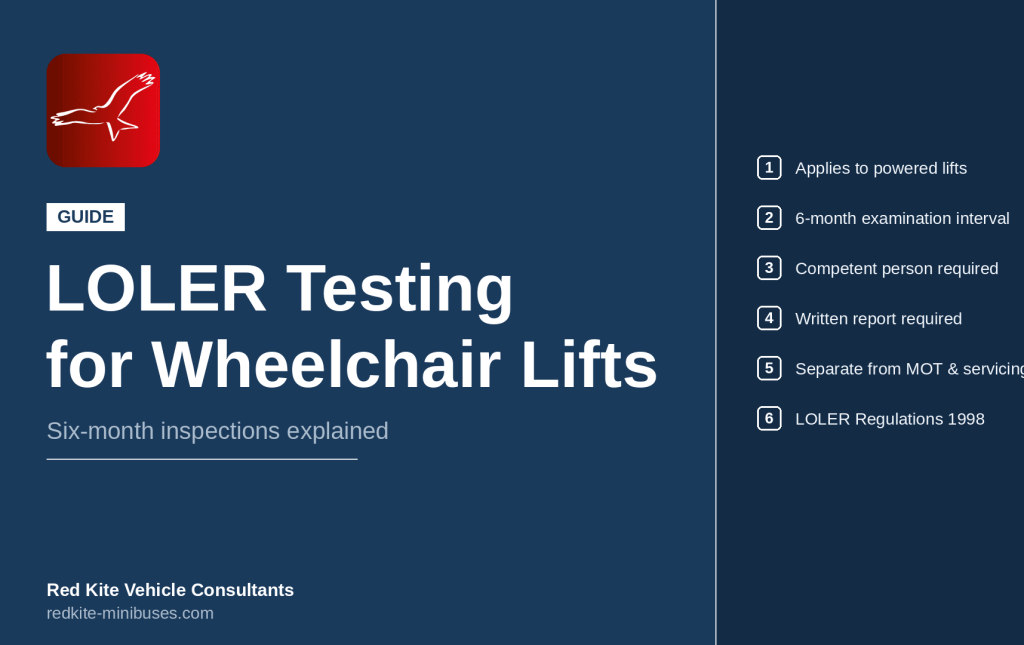
For lifting equipment used to lift people, the prescribed thorough-examination interval is normally six months, unless a competent person has established a different interval through a written examination scheme.
Yet LOLER is often confused with vehicle servicing, MOT requirements and other minibus compliance responsibilities. This guide explains what LOLER means for wheelchair lifts, who is responsible, what a thorough examination involves and how it fits into your wider maintenance arrangements.
Download the full LOLER compliance guide (PDF) →
Important: LOLER applies to lifting equipment used at work. Whether a particular wheelchair lift falls within its scope depends on how and where the equipment is used. If you’re unsure about your specific setup, check the latest HSE guidance or speak to a suitably competent specialist.
What Is LOLER?
LOLER stands for the Lifting Operations and Lifting Equipment Regulations 1998. It is UK health and safety legislation that applies to lifting equipment used at work.
The regulations are designed to ensure that lifting equipment is suitable for its intended use, properly maintained and examined at appropriate intervals. They cover equipment used to lift or lower loads, including equipment used to lift people.
A powered wheelchair lift fitted to an accessible minibus can fall within LOLER where it is being used as lifting equipment at work. Common types include platform lifts and other powered systems designed to raise and lower wheelchair users and their mobility equipment.
LOLER is concerned specifically with the lifting equipment and its safe use. It does not replace the vehicle’s normal servicing, maintenance or MOT requirements.
Does LOLER Apply to a Minibus Wheelchair Lift?
If a powered wheelchair lift is being used as work equipment to lift people, LOLER will generally apply and a thorough examination will normally be required.
The important point is that LOLER applies to lifting equipment used at work; it is not simply a rule that applies to every powered mechanism fitted to every vehicle.
For organisations such as schools, care providers and community transport groups, a wheelchair lift may form part of the equipment used to provide transport for passengers. The organisation should therefore establish whether the lift falls within LOLER and ensure that any applicable examination requirements are incorporated into its maintenance and safety arrangements.
LOLER operates alongside other requirements. A LOLER thorough examination does not replace:
- The vehicle’s MOT or other applicable roadworthiness requirements
- Routine servicing and maintenance
- Appropriate safety checks before use
- Relevant driver or passenger-assistance training
- Other health and safety requirements that apply to the organisation
How Often Does a Wheelchair Lift Need a Thorough Examination?
For lifting equipment used to lift people, the prescribed LOLER examination interval is normally at least every six months.
There is an important qualification, however. LOLER allows examination intervals to be established through a written examination scheme drawn up by a competent person. Where such a scheme applies, the equipment should be examined in accordance with it.
For many organisations operating wheelchair lifts, therefore, six-monthly thorough examinations are the practical interval to plan around, unless a competent person’s examination scheme specifies otherwise.
This is different from the interval commonly associated with general lifting equipment that is not used to lift people.
Keeping the examination date on the same compliance calendar as your vehicle servicing and other inspections can help prevent the next examination from being overlooked.
Who Is Responsible for Arranging a LOLER Examination?
Responsibility depends on the circumstances, but LOLER places duties on the employer and other people who have control of lifting equipment and its use.
For a school, care provider or community organisation operating its own accessible minibus, this will commonly mean that the organisation needs to make sure the wheelchair lift is properly maintained, examined where required and not used when it is unsafe.
In practical terms, this means:
- Identifying whether LOLER applies to your wheelchair lift
- Making sure the appropriate examination interval is established
- Arranging examination by a suitably competent person
- Keeping the report of thorough examination
- Acting on defects or safety issues identified by the examination
- Making sure the lift is not used where an identified defect makes continued use unsafe
The responsibility should not simply be assumed to sit with the minibus driver. An organisation should have clear arrangements identifying who manages its vehicle and lifting-equipment compliance.
Who Can Carry Out a LOLER Thorough Examination?
A LOLER thorough examination must be carried out by a competent person.
Competence means having the appropriate practical and theoretical knowledge and experience to examine the equipment, identify defects and assess their significance.
For a specialist wheelchair lift, organisations may therefore choose a suitably qualified inspection provider or specialist engineer with appropriate experience of the equipment involved.
The competent person should have sufficient knowledge of the type of lifting equipment being examined and should be able to make an objective assessment of its condition and safety.
What Happens During a LOLER Thorough Examination?
A thorough examination is a systematic examination of the lifting equipment to determine whether it remains safe for continued use.
The precise scope will depend on the equipment, how it is used, its condition, relevant manufacturer information and any applicable examination scheme.
Depending on the equipment, the examination may consider safety-critical elements such as:
- The lifting mechanism and structural components
- Load-bearing parts
- Safety devices and interlocks
- Controls and operating mechanisms
- Signs of wear, damage or deterioration
- Other components relevant to the safe operation of the lift
The competent person will then produce a report of thorough examination setting out the findings.
The report should be retained as part of the organisation’s equipment records, and any defects identified should be dealt with appropriately.
What Happens If a Wheelchair Lift Has a Defect?
Not every defect has the same significance, so the action required will depend on what the competent person identifies.
Where a defect creates an existing or imminent risk of serious personal injury, LOLER places specific reporting and use restrictions on the equipment. The relevant enforcing authority must be notified, and the equipment must not continue to be used until the relevant deficiency has been remedied.
Other defects may also require action within a specified period or before continued use, depending on their nature and severity.
The important practical point is that a LOLER report should not simply be filed away. The organisation responsible for the equipment needs to understand the findings and make sure appropriate corrective action is taken.
LOLER, PUWER and MOT: What’s the Difference?
These requirements can easily become confused, but they deal with different aspects of vehicle and equipment safety.
LOLER
LOLER concerns lifting equipment and lifting operations. Where applicable, it requires lifting equipment to be thoroughly examined at appropriate intervals and sets requirements for its safe use.
PUWER
PUWER stands for the Provision and Use of Work Equipment Regulations 1998.
Where applicable, PUWER covers wider responsibilities relating to work equipment, including its suitability, maintenance, inspection, information, instruction and training.
LOLER does not replace these wider work-equipment responsibilities.
MOT and vehicle maintenance
An MOT concerns the vehicle’s roadworthiness against the relevant testing requirements. Routine servicing and maintenance address the vehicle and its systems more broadly.
A successful MOT does not mean that a wheelchair lift has received its required LOLER thorough examination.
Likewise, a LOLER examination does not replace the vehicle’s MOT or normal servicing and maintenance.
For an accessible minibus, these should be treated as separate but complementary parts of the organisation’s safety and compliance arrangements.
LOLER and Section 19: How Do They Fit Together?
LOLER and Section 19 permits deal with different areas of compliance.
A Section 19 permit is relevant to certain organisations operating minibuses without a standard PSV operator’s licence. It is part of the legal framework governing how qualifying organisations can operate their vehicles.
LOLER, by contrast, concerns applicable lifting equipment and its examination and safe use.
Compliance with one does not automatically demonstrate compliance with the other.
For organisations operating accessible minibuses, it can nevertheless make sense to coordinate the different requirements. For example, vehicle servicing, safety checks, LOLER examinations and other compliance activities can be recorded within a single maintenance and compliance system, provided each requirement is still addressed appropriately.
You can read more about the Section 19 permit requirements on our Section 19 page.
Do Wheelchair Ramps Need LOLER Examination?
A conventional manual wheelchair access ramp would not normally be subject to the LOLER thorough-examination requirement in the same way as powered lifting equipment used to raise and lower people.
However, that does not mean a ramp can be ignored from a safety perspective.
Ramps should be appropriately maintained and checked for damage, deterioration, secure attachment and safe operation. Other work-equipment and workplace safety requirements may also be relevant depending on how the ramp is used.
If your vehicle has an unusual ramp, powered deployment system or combination of ramp and lifting equipment, check the specific equipment and current HSE guidance rather than assuming that LOLER does or does not apply.
What Records Should You Keep?
Where LOLER applies, organisations should retain the relevant report of thorough examination and make sure the findings are acted upon.
It is good practice to keep lifting-equipment records alongside your wider vehicle maintenance documentation so that you can see at a glance:
- When the last thorough examination took place
- When the next examination is due
- What defects were identified
- What corrective action was taken
- When servicing and other relevant inspections were completed
A simple compliance schedule can help prevent a six-month examination date from being missed.
Quick Reference: LOLER and Wheelchair Lifts
| Question | Answer |
|---|---|
| Does LOLER apply to a wheelchair lift? | Generally, where the lift is used as lifting equipment at work to lift people |
| How often is a thorough examination required? | Normally at least every 6 months for equipment used to lift people, unless a competent person’s written examination scheme specifies another interval |
| Who is responsible? | Usually the employer or other person with control of the equipment, depending on the circumstances |
| Who carries out the examination? | A competent person with appropriate practical and theoretical knowledge and experience |
| What do you receive? | A report of thorough examination |
| Does LOLER replace an MOT? | No. They address different requirements |
| Does LOLER replace servicing? | No. Routine maintenance and other applicable work-equipment requirements still apply |
| What about manual ramps? | A conventional manual access ramp would not normally be subject to LOLER’s thorough-examination requirement in the same way as lifting equipment, but it still needs appropriate safety checks and maintenance |
Frequently Asked Questions
“LOLER testing” is a commonly used term for the thorough examination of lifting equipment under the Lifting Operations and Lifting Equipment Regulations 1998.
Where LOLER applies, lifting equipment must be thoroughly examined at the appropriate interval by a competent person. For equipment used to lift people, the prescribed interval is normally six months unless a different interval has been established through a written examination scheme.
Where LOLER applies and the equipment is used to lift people, the prescribed examination interval is normally at least every six months.
A competent person’s written examination scheme may specify a different interval, so organisations should check their documentation rather than assuming that every item of lifting equipment has exactly the same inspection schedule.
A LOLER thorough examination should be carried out by a competent person with the practical and theoretical knowledge and experience needed to examine the particular lifting equipment and assess any defects.
For wheelchair lifts, this may be a specialist inspection provider or engineer with suitable experience of this type of equipment.
An MOT concerns the roadworthiness of the vehicle under the applicable vehicle-testing requirements.
A LOLER thorough examination concerns applicable lifting equipment and whether it remains safe for continued use.
They are separate requirements, so passing an MOT does not replace a LOLER examination where LOLER applies.
A conventional manual wheelchair ramp would not normally be subject to LOLER’s thorough-examination requirements in the same way as powered lifting equipment used to lift people.
However, ramps still need appropriate inspection and maintenance, and unusual or powered access systems may need separate consideration.
The action required depends on the defect identified.
If the competent person identifies a deficiency involving an existing or imminent risk of serious personal injury, specific LOLER reporting and use restrictions apply. The equipment must not be used until the relevant deficiency has been remedied.
Other defects may require action within a specified period or before continued use, depending on their nature and severity.
The findings in the report should therefore be reviewed promptly and any required corrective action completed.
The Health and Safety Executive (HSE) publishes guidance on thorough examination and testing of lifting equipment. Because legislation and official guidance can change, organisations should always check the latest HSE information when reviewing their compliance arrangements.
You can also seek advice from a suitably competent person if you’re unsure how LOLER applies to a particular wheelchair lift or vehicle setup.
Keeping Your Accessible Minibus Compliant
LOLER is one part of managing an accessible minibus safely. Depending on your organisation and vehicle, your wider arrangements may include vehicle servicing, MOT requirements, PUWER responsibilities, Section 19 requirements, driver training and regular safety checks.
Keeping these activities on a clear maintenance and compliance schedule can make it much easier to see what has been completed and what is due next.
Red Kite has over 30 years of experience supplying and supporting accessible minibuses for schools, care homes and community organisations across the UK. Our After-Sales Support team can advise on inspection scheduling and wider maintenance arrangements for your accessible vehicle.
Explore our range of wheelchair-accessible minibuses →
Or call 01202 827678 to discuss your accessible vehicle and compliance requirements.
Call Us: 01202 827678
Key Takeaways
- LOLER governs lifting equipment used at work, including wheelchair lifts on accessible minibuses.
- A thorough examination under LOLER should occur at least every six months unless specified otherwise by a competent person.
- Organizations must ensure wheelchair lifts are inspected and maintained according to LOLER, separate from other vehicle compliance requirements.
- LOLER responsibilities fall on employers and those in control of the lifting equipment, not just the minibus driver.
- Maintaining clear records of thorough examinations and compliance checks can streamline safety management for accessible vehicles.
This guide is intended as general information only and should not be relied upon as legal or regulatory advice. The application of LOLER depends on the circumstances in which lifting equipment is used, and requirements and official guidance may change. Always check the latest HSE guidance or seek advice from a suitably competent person regarding your specific vehicle and equipment.
Red Kite Vehicle Consultants Ltd, 3 Haddons Drive, Three Legged Cross, Wimborne, Dorset BH21 6QU Tel: 01202 827678 | Email: info@redkite-minibuses.com